Archive for the ‘Line 1’ Category

Dongmyo Station (동묘앞역) Line 1 – Station #127, Line 6 – Station #636

April 14, 2013

Dongmyo by Meagan Mastriani

Dongmyo Station takes its name from the nearby shrine, built to honor the Chinese general and deity Guan Yu (162-219).  Near-ubiquitous on the other side of the Yellow Sea, shrines like these are rare in Korea where, despite its long history as an on-again off-again vassal state to China, the strong Confucian tradition prevented worship of Guan Yu from ever really taking root.  So it was probably rather reluctantly that Dongmyo (동묘) was built, from 1599 to 1601, under the reign of King Seonjo (선조), at the behest of the suzerain Ming Dynasty.  A decade or so earlier, Ming forces had helped Joseon soldiers repel Toyotomi Hideyoshi’s invading Japanese during the Imjin War, a success that the Chinese attributed to the guiding influence of Guan Yu’s spirit.  Accordingly, acknowledgement was expected.

Dongmyo by Meagan Mastriani

Dongmyo by Meagan Mastriani

Dongmyo by Meagan Mastriani

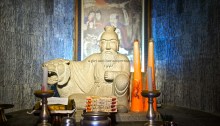
Several of these Munmyo, as shrines to Guan Yu are known, were built in Seoul, but the one just outside of Exit 3 is the only one remaining and is recognized as Designated Treasure No. 142.  Also known as Donggwanwangmyo (동관왕묘), the main shrine is formed by two attached buildings: the front section, or jeonsil (전실), is to be used for sacrificial rites, while the rear section, or bohnsil (본실) houses the statue of Guan Yu and some subordinate generals.  Distinct from similar buildings in the capital, Dongmyo’s design and decoration, predictably, incorporate many Chinese characteristics, including the intricate brickwork and its narrower width relative to its depth.  Though the main shrine building is closed to visitors, you can peer in through the wooden slats to view the large, gilt, seated statue of Guan Yu, his right hand raised and his beard reaching down to his knees.  To his sides are aides and retainers.

Dongmyo by Meagan Mastriani

Dongmyo by Meagan Mastriani

Dongmyo by Meagan Mastriani

On either side of the main shrine is a long wooden building, empty except for a large stone stele.  Forming the fourth side of the complex’s inner courtyard is an inner gate, the walls of which bear paintings of musicians and perhaps servants.  The paintings are badly faded, and it was only on the third time I walked through the gate that I noticed the faint outlines of human figures on what had at first appeared to be only slightly yellowed wood boards.  Looking closely, however, I could make out some of the details: the folds in a pair of pants, horns held up by two men, another with what looked like a pair of small cymbals.

Dongmyo by Meagan Mastriani

Dongmyo by Meagan Mastriani

Surrounding Dongmyo is the Hwanghak-dong Flea Market (황학동 벼룩시장), which you’ll practically stumble into the moment you step out of Exit 3.  Vendors line the sides of streets between Jongno (종로) and the Cheonggye Stream, particularly Jongno-58-gil (종로58길), where the deep burgundy sides and handsome black tile roofs of the adjacent shrine peek up from behind brick walls.

Dongmyo by Meagan Mastriani

Dongmyo by Meagan Mastriani

The median age of both vendors and buyers is somewhere north of 50, and interested parties stroll through the spillover from the larger area of flea market near Sindang Station: cleaning supplies, power cords, remote controls, artwork, comic books, portable cassette players, bass guitars, and just about whatever else you could throw on a pile, which, in some cases, is exactly how things are organized.  Not everything here is junk – a few antique shops can be found in the back alleys nearer the stream, and even some decent vintage pickups are available; the shop just outside of Exit 3 sold L.L. Bean flannels, which I haven’t seen anywhere else in the city.  And even if you aren’t looking to buy anything, simply wandering through and taking a close look at what’s there is sport enough.  My favorite spotting was a sheet of stamps from Sierra Leone featuring the Disney characters, including one that pictured the head mouse himself operating a backhoe underneath the tag, ‘Mickey mining bauxite.’

So close to Dongdaemun, you know that the flea market isn’t the end of the idiosyncratic shopping opportunities available here.  Dongmyo also provides quick access to a pair of specialty shopping areas we already visited via Dongdaemun Station.

Dongmyo by Meagan Mastriani

Dongmyo by Meagan Mastriani

Walking west from Dongmyo Station, Dongdaemun’s unmistakable vibe, that cocktail of ceaseless commerce and age, became more and more pronounced, and as I headed toward the old eastern gate from Exit 7 the sidewalk quickly got more and more filled up with street vendors.  The streets and alleys south of Jongno between Dongmyo and Dongdaemun Stations are where you’ll find the Stationary and Toy Wholesale Market (문구, 완구 도매시장), Toys ‘R Us’ wild, chaotic cousin, where playthings both authentic and fake fill the area.  Pink cellophane and cardboard box towers of Barbie and Barbie knockoffs stood alongside toy guns, English learning games, mountains of stuffed Brownie dogs, and Angry Bird pencil cases saying, ‘That’s the bomb!’  A string of plain white animal masks created a slightly eerie contrast with the otherwise cheery color palette dominated by bright blues, pinks, and yellows, and with the soundtrack of electronic chirps and squeals and recordings of kids singing bouncy, upbeat songs.

Dongmyo by Meagan Mastriani

Dongmyo by Meagan Mastriani

South of the toy market, is the Aquarium and Pet Market (애완동물 거리), most easily reached by heading straight from Exit 6.  After passing a cell phone shop with a big sign that read ‘no visa ok!’ I reached the Cheonggye, across the street from which is the strip of stores that make up the market.  Shimmering goldfish in tanks and the rocks and fake plants used to decorate their abodes were for sale, but so too were more exotic water dwellers like tiny aquatic frogs and water beetles (물방개).  Land-based pets ranged from hedgehogs to mice to bunnies who slept huddled up together against the cold.  The sound of the market was a nervous prattle raised by all the birds – common pet species like parakeets and cockatiels, but also chickens, roosters, doves, pigeons, and even a brilliant gold, brown, and ochre pheasant the color of autumn.

On the other side of the one-lane road, the Cheonggye Stream (청계천) continued its course toward the Han.  A group of rocks created a small cascade, and upstream of this the stream’s surface was frozen.  Water pouring out from underneath the firm shell tumbled over the rocks, leaving them wearing a fuzzy crown of ice and the water on the downstream side of the cascade unfrozen.

Dongmyo by Meagan Mastriani

Dongmyo by Meagan Mastriani

Dongmyo by Meagan Mastriani

South of Dongmyo Station may be full of idiosyncratic shopping areas, but to the north it’s largely residential, though it hardly lacks for things of interest; they’re just a bit harder to turn up.

Dongmyo by Meagan Mastriani

Dongmyo by Meagan Mastriani

Out of Exit 9, I passed a corner market with fresh produce and big bowls of shiny black mussels set out on the sidewalk and turned left on Jibong-ro-5-gil (지봉로5길).  Just a few steps up on the right is Naksan Naengmyeon (낙산냉면).  I first discovered this place when we visited Changsin Station, though it’s actually closer to Dongmyo.  I said it then and I’ll say it again: best naengmyeon in Seoul.  Purists might take issue with it, as the one and only thing they serve here isn’t true mul-naengmyeon (물냉면) nor is it true bibim-naengmyeon (비빔냉면), but something of a mash-up between the two, the only choice being how spicy you want it.  Perfectly chewy noodles; copious amounts of garlic, cucumber, and pears…I could go on.  Simply put, this place is the business.  Come any time even remotely around lunch or dinner and be prepared to wait.  Lines often go out the door.

Dongmyo by Meagan Mastriani

Dongmyo by Meagan Mastriani

Dongmyo by Meagan Mastriani

For no reason other than simple curiosity I followed Jibong-ro-5-gil past Naksan Naengmyeon, as it wound through the neighborhood, turning into a street lined with delivery motorcycles and mopeds, many with bars welded on behind the seat to provide a frame for goods loaded on the back.  After a couple 90-degree turns I stumbled onto Anyang Hermitage (안양암).  It looked small and rather anonymous, but it was there and I was intrigued by the huge rock slope that formed its southwestern boundary, so I decided to pop in for a quick look.

Instead of the usual fierce-looking door guardians, the pair on Anyang’s gates bore vaguely passive expressions.  They held their hands folded in front of them and rode fantastical animals, the one on the left astride a six-tusked elephant, the one on the right atop a blue lion.  The lack of aggression on their countenances seemed to validate the expectation that there really wouldn’t be anything special inside to protect, that this was the kind of temple neither human nor demon would bother with.  Once I stepped through the gate, however, I discovered that Anyang did indeed hold something special, the Rock-carved Seated Guanyin of Anyang Hermitage (안양암 마애관음보살좌상), Seoul Tangible Cultural Property No. 122.

Dongmyo by Meagan Mastriani

Dongmyo by Meagan Mastriani

Dongmyo by Meagan Mastriani

Carved onto that sheer rock face that had attracted me in the first place, the Guanyin is not particularly old, dating only to 1909, but it’s significant in that it was the last rock-carved Buddhist statue from the Joseon period.  The plaque inside Anyang explained that the hermitage was slightly older, having been established by Monk Yi Seongwol (이성월 스님) in 1889.  Among the structures there was the wood and brick Gwaneumjeon Hall (관음전), which had been built directly onto the rock slope to protect and enclose the Guanyin sculpture.  Its doors were closed and I couldn’t see the sculpture itself, but visible outside the hall was an inscription that had also been carved into the rock: over 100 Chinese characters explaining the statue’s carving by a skilled mason.

Dongmyo by Meagan Mastriani

Dongmyo by Meagan Mastriani

I wasn’t sure if the Guanyin sculpture was off limits to the public, but no one was around and so I decided to give a tug on Gwaneumjeon’s doors.  They stuck a bit but opened, revealing a figure seated in the lotus position within a shallow recess in the rock, a small altar and some unlit candles in front of him.  Unlike many Buddhist statues, this Guanyin looked distinctly Korean, with narrow eyes, rounded cheeks, and a wide nose, underneath which was a thin moustache and goatee.  On his lips there seemed to be a faintly pink hue, as if a small flicker of life existed within the carving.

Dongmyo by Meagan Mastriani

Dongmyo by Meagan Mastriani

The hermitage had a slightly mystical feel to it, created by its unexpected Guanyin image, its unusual rock formation, and its obscure location where I reckoned very few other foreigners had ever been.  The surrounding neighborhood too was vaguely mysterious in the way that very old Seoul neighborhoods sometimes are, full of tiny little alleyways that were often nothing more than poured concrete slopes and staircases running through the narrow spaces between homes.  Its agedness gave things a somewhat glum feel, which someone else had noticed and tried to ameliorate, as the area was spotted with bright, cartoon-y murals painted on the walls: a man blowing snot out of his nose, two girls flying atop a honeybee, another girl and her polar bear friend holding umbrellas.

Dongmyo by Meagan Mastriani

One other mural, dotted with hearts, simply read ‘꿈 꾸는 학교길’ (Dreaming School Street), but directly behind it was a derelict home that looked like a haunted house straight out of central casting.  A Western-style house, it had long been abandoned, and its façade was covered in dead ivy that also climbed up a crooked chimney.  Windows were missing glass, and beneath the ivy, the house’s plaster was peeling off everywhere, so badly that in some spots it had disappeared completely, revealing sections of rotting wood.

Dongmyo by Meagan Mastriani

Dongmyo by Meagan Mastriani

Anyang Hermitage isn’t the area’s only Buddhist spot of note.  Northeast of the station is Myogak Temple (묘각사), part of Korea’s Templestay program.  The temple isn’t far from the station, and it’s well signposted so isn’t too hard to find.  From Exit 2 turn left onto Jongno, then left again onto Jongno-63-gil (종로63길) and take the first right onto Jongno-63-ga-gil (종로63가길).  Follow this as it curves uphill until you come around a bend and spot the colorful temple façade.

According to the Korea Tourism Organization, Myogaksa was established by Monk Taeheo Hongseon in 1930 in a spot where it was said the building of a temple would bring peace to Seoul’s citizens.  That’s a pretty tall order for any one temple, but it does its best to offer it for at least a day or two with its one day or overnight Templestays, part of the popular Korea-wide program.  For details on program specifics see the link above.

Dongmyo by Meagan Mastriani

Dongmyo by Meagan Mastriani

The temple is separated from the road and the world outside by a sturdy stone wall, but just through its doors a set of stairs to the left lead up to the temple’s courtyard.  The courtyard is backed by a cliff where a stone Buddha is carved (much more typical looking than Anyang’s Guanyin figure), flanked by hundreds of tiny Buddha figurines lined up inside glass cases, each containing a tiny electric light that was lit up.  In the rock wall above was a tiny gold-painted niche where a small Buddha, maybe 20 centimeters tall, sat, and further up and to the left another gold Buddha, this one standing on a rooftop, looked out over the neighborhood to the south.

Dongmyo by Meagan Mastriani

On the courtyard’s left-hand side was a handsome building of wood and cream and clay-colored plaster, and on the right was a brilliantly painted hall, its main door covered in blue, red, white, and orange lotus carvings.  I climbed the stairs to the hall’s second floor and peeked in an open door where an enormous drum occupied one corner of the room and hanging lotus lanterns covered the ceiling from wall to wall.

Dongmyo by Meagan Mastriani

If instead of turning right onto Jongno-63-ga-gil you continue straight on Jongno-63-gil after leaving Jongno you can reach Sung-in Neighborhood Park (숭인근린공원).  At the end of Jongno-63-gil, on your right will be Mirin Temple (밀인사) with its unusual façade and large white ball on the roof.  Turn left onto Jongno-63-ma-gil (종로63마길).  After a couple dozen meters you’ll go up a small flight of concrete steps, after which you should immediately turn right onto a tiny brick alley (not the second right up more steps).  At the end of the alley will be a black metal fence with a small gate to the left – the entrance to the park.

Dongmyo by Meagan Mastriani

Dongmyo by Meagan Mastriani

Once inside, walking to the right took me right up behind the Buddha that stands on Myogaksa’s rooftop and then to a rough stone staircase running up alongside an empty stone water channel and into the main area of the park, a long plateau running along the top of the ridge the park sits on.

Dongmyo by Meagan Mastriani

Dongmyo by Meagan Mastriani

Dongmyo by Meagan Mastriani

Like any other park in Seoul, Sung-in has plenty of exercise equipment, mostly of the lightweight variety aimed at senior citizens who just need to get a little movement in, but in the northernmost section of the park (also accessible from Changsin Station) there was some more serious equipment, an outdoor weight room essentially, and four ajeosshis were taking advantage of it, getting in a workout in the brisk cold.  Sung-in is quite large, with quite a few badminton and basketball courts, a watercourse, and lots of trees.  It also has a very charming touch that I hadn’t ever seen in a Seoul park: a little shelter with a small bookshelf labeled Dongmang Peak Open Book Café (동망봉 열린 북 카페) where visitors – primarily kids, from the look of what was on offer – could borrow something to read while hanging out in the park.

Dongmyo by Meagan Mastriani

At the park’s southern end, near where the stone steps had dropped me off, was a lookout platform, and the views from the spot were long and clear.  Just below me was Myogaksa.  And there was Dongmyo.  A bit to the right was Dongdaemun Fashion Town.  And I was pretty sure that I could even pick out the bald rock face abutting Anyang Hermitage.  The city continued well away to the west, but to my left, to the east, it ended, and beyond was a ring of mountains, some of them still capped in a crown of snow.

Dongmyo (동묘)

Exit 3

U-turn, Right on Jongno-58-gil (종로58길), Left on Nangye-ro-27-gil (난계로27길)

Hwanghak-dong Flea Market (황학동 벼룩시장)

Exit 3

Stationary and Toy Wholesale Market (문구, 완구 도매시장)

Exit 7

Left on Jongno-54-gil (종로54길)

Aquarium and Pet Market (애완동물 거리)

Exit 6

Straight on Dasan-ro (다산로), Right on Cheonggyecheon-ro (청계천로)

Cheonggye Stream (청계천)

Exit 5 or 6

Straight on Dasan-ro (다산로)

Naksan Naengmyeon (낙산냉면)

Exit 9

Left on Jibong-ro-5-gil (지봉로5길)

Anyang Hermitage (안양암)

Exit 9

Left on Jibong-ro-5-gil (지봉로5길)

Myogak Temple (묘각사)

Exit 2

Left onto Jongno (종로), Left on Jongno-63-gil (종로63길), Right on Jongno-63-ga-gil (종로63가길)

www.myogaksa.net

Phone: 02) 763-3345, 763-3109

E-mail: yeodiamond@naver.com

Sung-in Neighborhood Park (숭인근린공원)

Exit 2

Left onto Jongno (종로), Left on Jongno-63-gil (종로63길), Left onto Jongno-63-ma-gil (종로63마길), Right after first set of stairs

Dongmyo by Meagan Mastriani

Hoegi Station (회기역) Line 1 – Station # 123, Jungang Line – Station # K118

January 27, 2013

Hoegi by Meagan Mastriani

On the north side of Heogi Station, maeul buses were pulling up and people in suits and fancy dresses were piling out, heading to the several wedding halls nearby.  Most of them crossed through the station to Exit 2, where, past a row of pojangmachas, guys in red jackets waved batons to direct cars out of a buffet parking garage.  Other invitees made their way into a particularly grotesque wedding hall where golden onion domes were paired with conical tower roofs dotted in square specks of color and capped with metal pennants, like a 64-bit version of a castle made real.

Hoegi by Meagan Mastriani

I walked to the end of the street, past a trio of girls singing along with the K-pop song coming out of one of their phones, and then hung a right onto Mang-u-ro (망우로), walking past a crafts shop where several chunks of wood had been carved into penis shapes and put in the window display.  In front of other shops, their keepers swept yellow ginkgo leaves off the sidewalk.

Hoegi by Meagan Mastriani

Hoegi by Meagan Mastriani

I walked down the street for a bit before doubling back and heading east, to Jungnang Bridge (중랑교) and the Jungnang Stream (중랑천).  Partway across the bridge a small set of stairs led down to the water.  There’s not much here, and the Jungnang, at least here, is barren compared to other streams in the capital.  The watercourse flows briskly, but there’s little separating it from the adjacent highway and little in the way of amenities.  Bike paths flank either side, and a short ways to the north is an inline skating oval, its lanes faded out, but the extent of facilities was a snack stall under the bridge where a woman sold ramen, chips, and beer to resting bicyclists.

Hoegi by Meagan Mastriani

Also on the south side of the station, about equidistant from Hoegi and Cheongnyangni Stations, is the University of Seoul (서울시립대학교), whose test for admissions may simply be finding the place.  Coming from the station, at the corner of Mang-u-ro-21-gil (망우로21길) and Mang-u-ro, cross the street, turn right, and take Mang-u-ro-16-gil (망우로16길), the diagonal street leading past several small restaurants.  At the small three-way intersection, next to a shop called Beauty Avenue, turn left (still Mang-u-ro-16-gil).  Walk to the end, where you’ll come up to a school.  Turn right, then an immediate left onto Mang-u-ro-18-ra-gil (망우로18라길).  Follow it uphill and around to the right.  At its end, the rear gate to the university is on your left.  Alternatively, after turning left at Beauty Avenue, turn right at Café Brown and Cocopop boutique.  Naver maps tells me this is Mang-u-ro-18-ga-gil (망우로18가길).  Follow this for a while until you see 한우 장터 and the bakery케익 이벤트 (Cake Event), where you should turn left, onto Mang-u-ro-18-na-gil (망우로18나길), before taking your first right, putting you back on Mang-u-ro-18-ga-gil.  Take that straight up to the rear gate.

Got that?  Didn’t think so.

Hoegi by Meagan Mastriani

Hoegi by Meagan Mastriani

Hoegi by Meagan Mastriani

The University of Seoul, founded in 1918 as Kyung Sung Public Agricultural College (경성공립농업학교), is one of the country’s highest-rated schools and, not surprisingly, has close ties to the city government.  Unlike many city campuses, U of S is surrounded by residential areas.  A cluster of cafes, cheap eateries, and convenience stores sit outside its main gate, but there’s relatively little to tip one off to the presence of a college of 15,000-plus students.

Hoegi by Meagan Mastriani

Hoegi by Meagan Mastriani

Hoegi by Meagan Mastriani

Inside the front gate is a stylized sculpture of the university’s logo, looking a bit like piano keys, and a bit further in the bronze figure of a hawk, the school’s mascot, perches atop a high pedestal.  The leafy campus is particularly pretty in fall, and several senior citizens were taking their exercise by strolling along the pathways.  At the very rear of campus is Sky Pond (하늘못), filled with small fish and the occasional carp, which swim around the pond’s little island and loiter underneath the footbridge.

While the U of S can be found on the south side of Hoegi Station, on the north side, via Exit 1, is Kyung Hee University (경희대학교).  Getting there is much simpler.  Turn left out of the exit, follow Hoegi-ro (회기로) to Kyung Hee-dae-ro (경희대로); turn right and walk up to the main gate.

Hoegi by Meagan Mastriani

Hoegi by Meagan Mastriani

The stretch from the station to the university is much more typical of a college neighborhood than the U of Seoul’s is, filled with the usual assortments of bars, restaurants, cafes, clothing boutiques, shoe shops, smoothie joints, accessory stores, nail salons, and the like.  Students crowd the sidewalks and you’re likely to hear snippets of Chinese interspersed with Korean.  Along with all the more usual university neighborhood businesses, you’ll likely notice an uncommonly high number of pharmacies here, particularly near the front gate.  The Kyung Hee grounds are also home to the Kyung Hee Medical Center (경희의료원), and the school is particularly well-known for its oriental medicine program, which, among other achievements, in 1972 successfully performed the world’s first drug-free anesthesia, using only acupuncture.

Hoegi by Meagan Mastriani

Hoegi by Meagan Mastriani

Past the handsome gray stone arch that marks the main entrance, the layout of Kyung Hee is similar to many other Korean universities, with a central drive leading up to a monument – in this case the University Motto Tower (교시탑), a white pillar topped by a world map and laurel wreath – and continuing to the university’s main building (본관).  Kyung Hee’s is a massive four-story structure with a large central pediment flanked by two smaller ones, each decorated with friezes and hanging over columned porticos.

Hoegi by Meagan Mastriani

On either side of the stairs leading up to the door are stone lions, the university’s mascot.  In front of the building is a circular pool with a central statue of three figures holding up a globe, beneath which a trio of thinkers study and contemplate.  Immediately behind the main building is a lovely and quiet pond, the surface of which was starred with crimson leaves from the trees on the surrounding hillside when I visited.

Hoegi by Meagan Mastriani

Hoegi by Meagan Mastriani

East of the main building is the Central Library and Central Museum (중앙도서관/중앙박물관), another imposing gray stone structure with arched windows on the fourth floor and a battlement along its top like on an English castle.

Hoegi by Meagan Mastriani

Hoegi by Meagan Mastriani

Hoegi by Meagan Mastriani

Perhaps the most noticeable building on campus is the Grand Peace Hall (평화의 전당), north of the museum and occupying one of the campus’ highest points.  It cops a fair bit of its design from French Gothic styles but also has stained glass windows depicting Boticelli’s ‘The Birth of Venus’ and what I think was a detail from his ‘Primavera,’ though I could be wrong on that one.  There’s also a window with the school’s lion mascot.  The whole thing’s a bit of a mess, but it does offer some great views, and you can make out N Seoul Tower far away to the southwest.

Hoegi by Meagan Mastriani

Hoegi by Meagan Mastriani

The bulk of the school’s facilities are east of these buildings.  Students played baseball on a large dirt athletic field ringed by crude concrete bleachers.  Tennis courts occupied the basin of an amphitheater that looked like it hadn’t been used in a long time.  Between the stage and the courts a small garden was walled off, holding almost as many mishit tennis balls as vegetables.  Surrounding these are many of the college’s class buildings, the most distinct of these being the Crown Concert Hall (크라운관), designed to look like, yes, a crown.  On a wall in front of it are depicted the Seven Wonders of the World, along with the Seven Wonders of Korea, which, according to…someone, include the Kyung Hee Diamond Garden and Cheomseongdae Observatory (첨성대).

Hoegi by Meagan Mastriani

The area south and west of Kyung Hee has a contemplative, heady atmosphere, thanks to the proximity of the university, two of the country’s most highly esteemed institutes of higher learning – Korea University and KAIST – and several research institutes and think tanks.  If, instead of turning onto Kyung Hee-dae-ro, you follow Hoegi-ro as it snakes around to the left, you’ll pass some of these, as well as more independent cafes and clothing boutiques ranging from vintage to toddler.

Hoegi by Meagan Mastriani

After a ways you’ll come to Hoegi-ro-10-gil (회기로10길), and if you turn left here the street will eventually bring you to an entrance to Hongneung Park (홍릉공원).  The park is rather large, but there’s actually not all that much that’s accessible to visitors, as most of it is covered by woods that spread out over a number of ravines.  While there may not be all that much to do as a result, it makes for an excellent place to escape from the city and stroll along its shady walking paths.

Hoegi by Meagan Mastriani

The park grounds are also home to a little-known historical site, though this is only accessible from a separate entrance.  To reach it, continue on Hoegi-ro until you come to Hongneung-ro (홍릉로).  Turn left there, continue past the Korean Film Council (KOFIK) (영화진흥위원회), and after a block the entrance to Yeonghwiwon and Sunginwon (영휘원과 숭인원) will be on your left.

Historical Site No. 361, these two tombs are the burial sites of Lady Eom (1854-1911) and Yi Jin, respectively.  Lady Eom, or Soonheon Hwang-Gwibi (순헌황귀비) was a favored concubine of Emperor Gojong.  She entered the palace when she was only five, eventually becoming a lady of the royal guard to Queen Myeongseong.  She remained in the palace until she was 32, when the queen, in a fit of rage, threw her out after ‘she had a chance to serve King Gojong at night,’ as the Cultural Heritage Administration of Korea’s website preciously phrases it.  Nine years on, however, Empress Myeongseong was murdered by Japanese assassins, and a mere five days later Lady Eom returned to the palace.  (Incidentally, the tomb of the empress was originally located near here, before being moved to Namyangju in 1919.)  She made good by helping Gojong escape to the Russian legation.  Following this, and prior to official Japanese annexation of Korea, Lady Eom acted on her interest in Western education by founding the Yangjeong School (양정의숙) in 1905 and the Jinmyeong Girls’ School (진명여학교) the following year.  She also later donated a large sum of money to found Sookmyung Girls’ School (숙명여학교).

Hoegi by Meagan Mastriani

Sadly, there’s far less to say about Yi Jin, Lady Eom’s grandson by her son Uimin, who was the last Joseon imperial crown prince.  Uimin was taken hostage and sent to Japan at the age of 11 under the pretext of ‘studying abroad,’ which has to be some of the greatest political spin of all time.  In 1920, in an arranged marriage he wedded Japanese Princess Masako Nashimoto, who gave birth to Jin the following year.  Nine months later, however, during a visit to Korea, their first-born died under what are often referred to as suspicious circumstances.  King Sunjong, Uimin’s elder brother, declared that Sunginwon should be built as a resting place for the deceased infant.

After entering and passing a handy display of the Joseon Dynasty royal family tree, Sunginwon is the first of the tombs you come to.  A wooden gate frames a stone path leading up to a squat wood memorial hall.  Half-moon-shaped wooden aprons hang down from the roof on the front and sides, the one on the north side the only one that still retained much of its vivid burgundy paint.  Nothing was inside the hall, only washed-out roof beams and black stone tiles on the floor like those leading up to the structure.  A pavilion south of the hall held a stele.  Behind the two structures was a mound, which flattened out at the top.  On this flat area was a smaller burial mound surrounded by stone lanterns, stone animal and human guardians, and a brick wall.  The steepness of the hill meant that the only way to get even a partial view was to back way up.

Hoegi by Meagan Mastriani

The area between Sunginwon and Yeonghwiwon was filled with Korean honey locusts and other trees, including a red hawthorn that is Natural Monument No. 506.  Estimated to be 150 years old, its twisted branches twine around each other, dozens of berries still clinging to them in the late autumn cold.

Yeonghwiwon had a similar setup to Sunginwon, but was slightly bigger and in better shape, its paint sharper and less faded, and with a wider and less steep hill.  Like Sunginwon, there was a pavilion holding a stele to the south, its outer edge also serving as a hangout for seven old women, bundled up against the cold, and a lone man in a wheelchair who was resolutely not paying attention to the women’s gossip.  Unlike the other memorial, however, this hall was not empty, instead having several tables inside.  A sign noted that a memorial ceremony (기신제) is held here every April 13.

Hoegi by Meagan Mastriani

Finally, any visit to Hoegi, and particularly one in winter, should culminate with a trip to Pajeon Alley (파전골목), back near the station.  Just before Hoegi-ro’s intersection with Imun-ro (이문로) is Hoegi-ro-28-gil (회기로28길), to your left.  The alley runs past eleven pajeon restaurants before turning into a low tunnel running under the train tracks.  I had to duck as I walked, but I watched two moped deliverymen who knew their height exactly zip through, their helmets not more than an inch or two from the ceiling.

Hoegi by Meagan Mastriani

Hoegi by Meagan Mastriani

A friend and I picked one of the restaurants more or less at random, trying out 이모네 왕 파전, which is open 24 hours.  The place was already busy at 5:00 on a Saturday evening, slightly raucous and full of students from the nearby universities.  We were ushered into its warren-like interior, one of the ajummas literally pushing me in my back (in a not unfriendly way) to guide me to where she wanted us to sit.  The floor was hot from the ondol, and I stripped down to just my t-shirt, which felt wonderful after coming in from the cold.  The walls of the restaurant were covered in a plain cream wallpaper that had been turned into a public sketch pad.  Graffiti and doodles – caricatures of people, drawings of bunnies and scheming pandas, birthday wishes declarations of love or of what menu item someone ordered – covered the walls. [Disclaimer: Meagan's photos were taken at another restaurant, 낙서 파전.]

Hoegi by Meagan Mastriani

Hoegi by Meagan Mastriani

Feeling hungry and, it turned out, too optimistic, my friend and I ordered Set B – pajeon, fried meatballs (동그랑땡), gochu twigim (고추튀김), tteokbokki, and corn (옥수수콘) – along with a bottle of makkeolli.  When the pajeon came it was deep and stuffed to excess with green onions and octopus, the pajeon equivalent of a Chicago deep dish.  The other fried foods were crisp, hot, satisfying, and plentiful, and the lesson we learned was that a set for just two people is a mistake.  Best bring at least three.  I wound up having leftovers for dinner for the next two days.  While over-ordering may pain your stomach, it most definitely won’t pain your wallet.  For the set and makkeolli, we paid only 25,000 won; a pajeon alone is only 7,000, much cheaper than you’ll get it for at most other places.  The prices mean you don’t need to worry about passing a long while here, and as Seoul loiters in its deep winter chill there are few better ways to wait for spring than sitting on a hot floor with heavy, satisfying food and the kindling of warm friends and warm conversation.


Jungnang Stream (중랑천)

Exit 2

Straight on Mang-u-ro-21-gil (망우로21길), Left on Mang-u-ro (망우로)


University of Seoul (서울시립대학교)

Exit 2

Straight on Mang-u-ro-21-gil (망우로21길), Right on Mang-u-ro (망우로), Left on Mang-u-ro-16-gil (망우로16길), Keep Left onto Mang-u-ro-16-gil, Right on Mang-u-ro-18-ga-gil (망우로18가길), Left on Mang-u-ro-18-na-gil (망우로18나길), Right on Mang-u-ro-18-ga-gil


Kyung Hee University (경희대학교) and Kyung Hee Medical Center (경희의료원)

Exit 1

Left onto Hoegi-ro (회기로), Right on Kyung Hee-dae-ro (경희대로)


Hongneung Park (홍릉공원)

Exit 1

Left onto Hoegi-ro (회기로), Left on Hoegi-ro-10-gil (회기로10길)


Yeonghwiwon and Sunginwon (영휘원과 숭인원)

Exit 1

Left onto Hoegi-ro (회기로), Left on Hongneung-ro (홍릉로)

Hours | February – May 9:00 – 18:00, June – August 9:00 – 18:30, September – October 9:00 – 18:00, November – January 9:00 – 17:30; Closed Mondays

Admission | Adults 1,000원, Children 7-18 500원

Phone | 02) 962-0556

Website | eureung.cha.go.kr


Pajeon Alley (파전골목)

Exit 1

Left on Hoegi-ro (회기로), Left on Hoegi-ro-28-gil (회기로28길)

Hoegi by Meagan Mastriani

Jegi-dong Station (제기동역) Line 1 – Station #125

January 6, 2013

Jegidong by Meagan Mastriani

My girlfriend and I got off a mid-afternoon train at Jegi-dong Station along with about 40 other people.  From a quick scan down the platform, it looked as if we were the only ones under 50.  This may not be especially surprising, given that Line 1 runs through older parts of town popular with an older crowd, but of those Line 1 stations, Jegi-dong in particular has a close association and a long history with the elderly, the ill, and the convalescing.  This is most apparent at the neighborhood’s well-known herbal medicine market, but the tradition goes back much further.

Jegi-dong by Meagan Mastriani

Jegi-dong by Meagan Mastriani

Jegi-dong by Meagan Mastriani

Northwest of the station, out Exit 1, and right on Muhak-ro (무학로) is Anam Rotary (안암로터리).  Now an area packed with cheap restaurants, bars, cafes, cell phone shops, and other things betraying its proximity to Korea University (고려대학교), it was once the site of the Bojewon (보제원), the Joseon royal hospital, as a plaque on the rotary’s southeast side notes.  Located in a spot convenient to travelers approaching Dongdaemun (동대문), the city’s east gate, from 1393 to 1895 the hospital gave free accommodation to travelers and provided medicine for the sick, as well as hosting the occasional banquet for a retired statesman.

Jegi-dong by Meagan Mastriani

Jegi-dong by Meagan Mastriani

Those looking to learn more about the history of medical care and Oriental medicine in Korea can visit the Seoul Yangnyeongsi Herb Medicine Museum (서울약령시한의약박물관), a block or so down Wangsan-ro (왕산로) from Exit 3.  So you say to yourself, ‘I am not one of those’?  Well, I said that too but I went anyway, and I’m kind of glad I did.  A visit to the museum begins overdramatically, with a brief video of symbols and herbs whooshing across a wall-size screen, before the screen reveals itself to actually be a door and opens, ushering visitors into the exhibit hall.  Once inside, however, things are more modest, and better.  For starters, the museum is small.  An hour would likely be enough for an exhaustive viewing.  (There are additional facilities in the museum where you can sample herb tea, grind your own medicine and get a health checkup.)  It’s also neatly arranged and informative, while also recognizing that most visitors aren’t looking for overly exhaustive explanations.  Most, though not all, exhibits have basic English explanations.

Jegi-dong by Meagan Mastriani

We were escorted into the exhibit by a smiling, grandfatherly old attendant dressed in everyday hanbok who spoke fluent Japanese and enough English to endear himself.  Inside there’s a miniature recreation of Bojewon, old tools and medical tracts, information on famous Korean physicians, and the Dongindo (동인도), an anatomical chart for acupuncture.  The most eye-catching display is the jars of all the various herbs and animal (parts) used in traditional Korean medicine, including, but not limited to, seahorses, frogs, geckos, bats, and deer penis.

Jegi-dong by Meagan Mastriani

Jegi-dong by Meagan Mastriani

Jegi-dong by Meagan Mastriani

Considering the inclusion of some rather unique ingredients in traditional medicine, it may behoove potential shoppers to pay the museum a visit before heading to the Seoul Herbal Medicine Market (서울약령시), just outside Exit 2.  Past the merchants clustered around the exit selling Korean sweets, fruits, and dried fish, the side streets to the north are about the closest thing to a real-life Diagon Alley you’re likely to find anywhere.  Tart-sweet odors fill the air; bundles of sticks and twigs dangle from metal grilles; foot-long dried fish bound together at their tails hang suspended upside-down, their open mouths fanning out at angles in a toothy bouquet; bags of roots, mosses, and dried flowers, the lips of the bags rolled down, sit on tiers outside of shops; elk and deer horns rest on shelves; ginseng floats suspended in bulbous glass vases full of alcohol, their tendrils drooping and splayed like the map of a river delta; and grand wood Chinese medicine chests nearly take up entire walls, segmented into dozens and dozens of identical drawers, each with one or two Chinese characters on either side of a plain knob, concealing the potions kept inside.

Jegi-dong by Meagan Mastriani

Jegi-dong by Meagan Mastriani

Formalized herbal medicine markets were first established during the reign of King Hyojong (1649-59) in Daegu, Jeonju, and Wonju, and were held twice a year, in spring and fall.  They spread and then contracted, and now there are two such markets in Korea: the one in Daegu and the one in Seoul.  The Jegi-dong market covers 265,000 square meters, has over 1,000 clinics, wholesalers, and resale shops, and deals 70% of the Oriental medicine in the country.  Most of the herbs and remedies for sale here come from China, and most things are grown on herbal medicine farms, as a worker at Songgang Oriental Clinic (송강한의원) told me as I looked at five-centimeter diameter cylinders of centipedes tied together.  There were some from China, some from North Korea, and some from South Korea, which, I was informed, are the best.  Drinking the water that they’ve been boiled in is supposed to be good for your back, rheumatism, and stomach cancer.  Or so I’m told.  I’m going to have to take that one on faith.  Things that may be rather more palatable are what Songgang’s employee told me are good for winter colds and flus: Chinese bellflower (도라지), omija (오미자), and liriope (맥문동).

Jegi-dong by Meagan Mastriani

Jegi-dong by Meagan Mastriani

The Herbal Medicine Market is a vital piece of tradition in the modern city, probably one of the few places where you’ll still sometimes see men strolling about in hanbok, but it’s just one part of an entire neighborhood of markets.  The sidewalk in front of the Herbal Medicine Market is a riot of butchers, grain sellers, octopus tentacles on ice, and spillover medicinal goods, like the jagged aloe leaves laid out at one stall.  Following the sidewalk and then crossing Gosanja-ro (고산자로) brings you to Gyeongdong Market (경동시장), an enormous place that, much like Jungang Market (중앙시장) at Sindang Station had, stunned me simply by virtue of its existence.  It was huge, but I’d never ever heard of it, likely because this too is a locals-only place – northeast Seoulites getting groceries and that’s it.

Jegi-dong by Meagan Mastriani

Dusk and a light rain were falling when I arrived, and bare light bulbs in market stalls were flicking on, giving the streets and interior aisles a sheen.  A string of ginseng sellers had roots piled up on tables, as did the chicken seller with dozens of whole raw birds.  Ears of corn were half shucked, displaying the purple kernels to passers-by; beans sat in big mesh bags and ruby red apples in cardboard boxes.  Chopped-off heads and tails filled a white bag at a fishmonger’s stall, and someone else sold brown arrowroot (생칡즙) and camouflage-green motherwort juice (익모초즙) from the same type of plastic containers that dispense slushees at 7-11.  My girlfriend, a born-and-raised Seoulite, said the market felt more like China to her than Korea, and I had to agree.

Jegi-dong by Meagan Mastriani

Jegi-dong by Meagan Mastriani

Gyeongdong runs into Cheongnyangni Wholesale Market (청량리 청과물 도매시장), so that it’s hard to tell where one ends and one begins, but the latter seemed to be a bit closer to Cheongnyangni Station, so we’ll save it for when we visit that stop.

Jegi-dong by Meagan Mastriani

As perhaps is to be expected, much of the neighborhood has a pretty old school vibe, and we first noticed this before we even left the station, where an old 차타는곳 sign hung by Exit 5.  Just outside the exit is the Jeongneung Stream (정릉천), lined by old, rundown three-story apartments.  We visited its lower stretch when we were at Yongdu Station, and as we’d noticed then, the part near Jegi-dong had a very low water level, trickling through mud and the space between stepping stones.  Further upstream it was stagnant and algal.  Some older neighborhood residents were using the streamside exercise equipment or reading the paper under a bridge.

Jegi-dong by Meagan Mastriani

Paralleling the watercourse north along Muhak-ro, a block down Wangsan-ro from Exit 1, I first came to Yongdu Market (용두시장), near the corner of the two streets.  At Muhak-ro-37-gil (무학로37길) we noticed a little stand holding a baby pine tree that had been painted with an advertisement: 이발 컷트 4,000 (Haircut 4,000 won).  The barbershop in question was located in a decrepit-looking building – gray paint peeling everywhere, revealing concrete just a shade darker underneath it like a blotchy rash – that also housed a tiny restaurant and the small Yongdu Market.  In addition to 4,000 won cuts, the barbershop offered a 1,000 won discount if you were over 80 and coloring for 5,000.

Jegi-dong by Meagan Mastriani

Jegi-dong by Meagan Mastriani

Surrounding the market were machinists and smithies scattered about in equally old buildings.  A group of old men was playing Go Stop inside one doorway and a separate group of old women was doing the same as they cleaned vegetables.  Other machine shops were on Muhak-ro on the way north to Anam Rotary, including one where the smooth croon of Frank Sinatra was pouring out of the stereo.

Jegi-dong by Meagan Mastriani

Jegi-dong by Meagan Mastriani

On the southwest side of the Muhak-ro – Wangsan-ro intersection is the Korea Aviation College (한국항공전문학교) and on the street outside, sitting on a wheeled frame was a used turbofan engine, rather banged up, but oddly impressive in a I’ve never actually seen a turbofan engine, let alone just sitting on the streets of Seoul kind of way.

Before you get to that, however, coming from the station (Exit 6) you’ll notice another piece of sidewalk art: a gold-colored statue of a saluting baby squid marking, as is noted on the statue’s base, 용두동쭈꾸미특화거리, Yongdu-dong Jjukkumi Specialty Street.  The area around this side of the intersection is known for having a number of restaurants that serve jjukkumi, and my girlfriend and I went to one, 나정순할매쭈꾸미(Na Jeong-sun Halmae Jukkumi) for dinner.  As we took our shoes off one of the workers asked us how many were in our party, and before we even sat down the jjukkumi in its blood red sauce was on our table’s burner, cooking away.

Jegi-dong by Meagan Mastriani

Jegi-dong by Meagan Mastriani

The jjukkumi came with sesame leaves (깻잎), and each table had bins of garlic, pickled garlic, chopped carrots, ssamjang (쌈장), and a wasabi and soy sauce.  I went through a lot of carrots.  I love spicy food, and have a pretty high heat tolerance, but the jjukkumi, like nakji bokkeum (낙지볶음), was one of the spicier things I’ve had in Korea, with a heat that accumulated so that the first bite wasn’t particularly potent but each subsequent one built a little bit on the heat from the last one so that by the end of the meal I was grateful for the bokkeumbap (볶음밥) that used up the rest of the sauce and neutralized much of its heat.  And I’d happily submit myself to it all over again tomorrow, a submission I’d hardly be alone in.  We arrived just before 6 p.m. and got the second to last table, and the place was ceaselessly full until we left, 나정순 herself steadily turning people away with a brisk ‘No tables!’

Bojewon Site (보제원)

Exit 1

Right on Muhak-ro (무학로) to Anam Rotary (안암로터리)

Seoul Yangnyeongsi Herb Medicine Museum (서울약령시한의약박물관)

Exit 3

Straight on Wangsan-ro (왕산로)

Hours | March – October: 10:00 – 18:00; November – February: 10:00 – 17:00; Closed Mondays

Admission | Free

museum.ddm.go.kr

Phone: 02) 3293-4900~3

Fax: 02) 3293-4905

Seoul Herbal Medicine Market (서울약령시)

Exit 2

Gyeongdong Market (경동시장)

Exit 2

Straight on Wangsan-ro (왕산로)

Jeongneung Stream (정릉천)

Exit 5

Yongdu Market (용두시장)

Exit 1

Straight on Wangsan-ro (왕산로), right on Muhak-ro (무학로), left on Hanbit-ro (한빛로)

Yongdu-dong Jjukkumi Specialty Street (용두동주꾸미특화거리)

Exit 6

Straight on Wangsan-ro (왕산로)

나정순할매쭈꾸미(Na Jeong-sun Halmae Jukkumi)

Exit 6

Straight on Wangsan-ro (왕산로), left on Muhak-ro (무학로)

Phone: 용두 Branch – 02) 928-0231, 제기 Branch – 02) 957-3310

Jegi-dong by Meagan Mastriani

Yongsan Station (용산역) Line 1 – Station #135, Jungang Line – Station #K110

May 20, 2012

Yongsan web-11

It may serve as Seoul’s secondary train depot, but say the words ‘Yongsan Station’ and the first thing anyone thinks of is the sprawling electronics and technology market occupying the neighborhood to the west, an agglomeration of shops and buildings so large, so jumbled, and so exhaustive in its offerings that anyone who is not either a rabid technophile or a veteran explorer of the market may, by the end of a visit, find themselves entertaining fantasies of trashing their toaster and moving to a cabin in Idaho.  Tech-heads, on the other hand, may feel they’ve died and gone to heaven.

Yongsan web-9

While not quite a Luddite, I definitely fall into the former category, and after a few tepid visits to the market in the past I was hoping that this visit, with more time and less purpose, would finally be the one to, if not quite give me a sense of comfort with the place, at least ease my sense of panic when I go there.  But first, I had to get out of the station, which offers its fair share of reasons not to.

Yongsan web-1

If you take the subway to Yongsan, you’ll exit through the station’s central hall, a bright, cavernous space crisscrossed by singles and small groups on their way to or from a train.  Beneath the molecule and UFO-like sculptures hanging from the ceiling, other passengers sit around snacking on ice cream, watching one of the station’s TVs, or merely staring into space waiting for their boarding time as the echoing announcements of a delayed train bounce off the walls.

Yongsan web-2

After exiting through the central doors, a wide corridor separates the station from the I’Park Mall.  Before going inside, though, I walked up the steps just outside the exit doors to what’s called the Event Park, an open plaza that, for the moment at least, held a small ice rink.  It was slowly melting in the early March sunshine, but about eight or nine determined girls continued to cut their way through the slush.

Yongsan web-3

Walking back down, I entered the first floor of the I’Park Mall, which is actually the third floor as ground level is a couple stories down.  Immediately I was greeted with solicitations of ‘Hello, camera.  Digital camera.  Mp3,’ from the eager salesmen whose booths line the fluorescent-lit aisles.  For many people the I’Park Mall is the first (and sometimes only) encounter they have with Yongsan’s electronic commerce, and although it’s more convenient and certainly nicer than the market proper, prices here tend to be higher as well, and the salespeople can be a bit on the pushy side.  The 3rd floor holds mostly cameras and mp3 players, the 4th floor more of the same, along with home appliances like TVs and vacuums, and the 6th and 7th floors laptops (including a small area labeled ‘Laptops for Foreigners’).  If you turn back towards the station you’ll escape the gadget glut for a bit and end up in regular old mallsville: clothes, housewares, food courts, etc.

Yongsan web-4

Yongsan web-7

Yongsan web-5

Keep taking the escalators up, though, and on the top floor you’ll come to the rather unassuming looking E-sports Stadium (전자경기장), where the battles in Korean computer gaming’s top league, the SK Planet Starcraft Pro League, take place and are filmed for broadcast on the TV channel dedicated to the video game.  I’d been wanting for quite some time to watch some professional gaming live, not out of any particular interest in Starcraft (of which I have none), but because when one is in a foreign land it’s both edifying and entertaining to observe the natives as they pursue their traditional sport.  I’ve been to a bullfight in Seville, an intra-city soccer derby in Rome, a muay thai bout in Chiang Mai, and a shopping mall in Singapore.  Starcraft in Seoul was naturally next on the list.

Yongsan web-6

Luckily enough, I happened to stumble upon a competition taking place.  The arena(?) is about the size of a large café, and was packed – standing room only.  The crowd, which was 90% male, either sat in the rows of gray plastic chairs at the front or merely stood around, shoulder to shoulder, in the open space at the back.  On either side of the room, in front of banners bearing the names and logos of the League teams (Samsung KHAN Pro Game Team, Air Force ACE, CJ ENTUS), teammates of the present competitor sat in more plastic chairs, watching the action and awaiting their turn.

Their gaze was directed at an enormous video screen at the front of the room that broadcast the action (if that’s the right word), occasionally cutting away for brief shots of the competitors’ faces, which remained perfectly inscrutable throughout the match.  The competitors, dressed in tracksuits bearing the logos of various sponsors, like a NASCAR driver’s jumpsuit, sat in large angular glass boxes at either end of an elevated stage.  Between them a trio of announcers kept up a rapid-fire running commentary, and although the players wore headsets I wondered if the play-by-play still seeped in, which would provide the strange sensation of hearing your decisions analyzed and critiqued as they were being made.

Before even the gameplay, the first thing I noticed when I walked in (Which you can just do, by the way.  Admission is free.) was how incredibly quiet the crowd was.  For anyone who’s been to a baseball or soccer game here, or even just watched on TV, you know how loud and enthusiastic Korean sports fans can be.  The audience here, though, conducted themselves exactly the way one does when one watches TV or sits in a PC bang: largely silently, minimal blinking.  In the ten minutes it took for the two competitors to build up their armies from the time I entered, the crowd, so much a part of the live sports experience, did almost nothing.  It wasn’t until the first attack that a very mild Ooooh rose up from some of them and one guy off to my left, looking for some sort of outlet for his excitement, hopped up and down in place a bit.

And yet, as I watched and as things vaguely started to make more sense, I began to get the appeal of the game, not just as a game but as a spectator sport.  Its draw lies in the excitement of watching a war where something is at stake, but nothing matters.  There’s no carnage and no consequences, but there are all of the things that make battle entertaining: strategy, conflict, the victor, the vanquished.  I love those TV shows that chart out and reenact the strategies, the mistakes, the gambits, and the sheer dumb luck that led to historical military conflicts turning out the way they did.  Watching how an army of Zergs overruns an army of Terrans in real time isn’t all that different from watching how the English fleet did the same to the Spanish Armada or how the French outlasted the Germans at Verdun.

Finally, after about 20 minutes, a brief round of clapping and a few tentative cheers went up.  It was over.  The guy with the red things had defeated the guy with the blue things.

Yongsan web-17

Turn left out of the station exit instead of walking directly into the mall, and you’ll arrive at the top of a large flight of steps leading down to Station Plaza, a paved space with some benches and a giant metal ring off to the right.  From the top of the steps, a couple stories up, you can see several skyscraping apartment towers in the distance, their newness and shine a match for the structure you’re currently standing in, with its spotless waiting room, E-Mart and CGV Imax.  In the near distance, though, just across Hangang-daero-23-gil (한강대로23길) from the plaza, things look quite different.  Several shuttered businesses are visible, along with the tops of scaffolding, and, a bit further up the street, empty buildings that have had some of their upper floors half-demolished.

Yongsan web-15

Yongsan web-16

Yongsan web-14

Along with its electronics market, the other feature that the area around Yongsan Station used to be known for was the red light district just across from it.  Until relatively recently, the parallel street only one block back from Hangang-daero-23-gil was lined with pink-lit rooms where girls waited for customers behind full-length windows.  That’s all gone now, as the city has focused on development and gentrification, but a walk down the backstreet revealed that a handful of those glass rooms are still there, only now there’s tape over cracks in the windows and all that’s inside is broken glass and other detritus.  Mostly, things are just gone, torn down.  Several lots along the alley are just piles of rubble: chunked concrete and metal behind cloth-covered fences.

Yongsan web-13

It’s not just the red light district that’s seen the end of the line here.  Across from the Yongsan E-mart was a collection of well-known gamjatang restaurants, but these too have been gutted, and in the area behind them partially demolished buildings wait for the coup de grâce; for now their upper floors gape half open like a cross-sectioned diagram.  Even more than in other parts of the city, the redevelopment of Yongsan has been particularly contentious, with residents having claimed inadequate compensation and intimidation by armed thugs.  Fierce opposition by some of the area’s residents to their forced evictions reached a tragic culmination in January 2009 when police raided a building that Molotov cocktail-armed protestors had occupied.  At some point in the ensuing battle a fire broke out, and by the time things had ended five protestors and one police officer were dead.

But the struggle over the future of Yongsan is not yet over.  The 2009 fire occurred in Yongsan District 4.  When I left the station I noticed a long banner that had been strung up directly opposite Station Plaza proclaiming ‘We are not giving this land to thieves.’  It was signed the Union of Yongsan District 3 Residents.

Yongsan web-18

Yongsan web-19

Yongsan web-22

Finally, the moment came for me to venture into the Yongsan Electronics Market (용산전자시장).  Taking a deep breath I headed across the long covered walkway that leads from the side of the corridor opposite the steps to Station Plaza, over what’s currently a large empty lot, and into the market’s first building, Yongsan Terminal Mall (용산터미널상가).  Similar to the tech part of I’Park Mall but older, Terminal covers several floors of cameras, computers, mp3 players, and accessories.  Step out the back door and on the sidewalk next to the parking lot is a collection of guys selling pirated DVDs, everything from the latest Hollywood blockbuster to The African Queen to an Art Garfunkel concert.

Yongsan web-20

Yongsan web-21

Yongsan web-23

Not far away, past a line of snack shacks and DVD hawkers, is Seonin Mall (선인상가), which specializes in computer parts.  If you’re a hardcore computer geek, more interested in building your own machine than buying one, this is the place to come.  A bit surprisingly, even to myself, it’s the one place in the market that I kind of actually like going to.  There’s something fun about looking at all of the spare parts – motherboards, processors, uh…chips, and umm…uh, bytes and stuff? right? – and the salesmen have been friendly and helpful on the pair of occasions when I’ve needed something.  This time I had brought along my laptop, which had lost a couple of screws from its underside, and when I asked the guy who had replaced them how much it cost he just waved me off.

Yongsan web-24

Yongsan web-26

Yongsan web-27

Across the parking lot from Terminal is Najin Mall (나진상가), specializing in phones and video games, though it was quite quiet as I walked through, and it looked as if many businesses had moved out.  Next to that, just to the west, stood the ET Land Main Building (전자랜드본관) and ET Land New Building (전자랜드신관).  I passed a Discman and portable cassette player on my way in, but other than that the merchandise in there was the same as in the Main Building and as in the Terminal Electronics Mall and as in the I’Park Mall, and I started to ponder something I find myself pondering a lot in Seoul, namely, how do all of these businesses that sell basically the same thing in the same area all manage to stay in business?  There was a smattering of shoppers in the ET New Building, but they didn’t seem sufficient to support it long-term, to say nothing of necessitating an expansion to a second structure.

Yongsan web-29

The places I’ve mentioned here are only some of the main ones in the market, which, just when you begin to think there can’t be any more to it, reveals yet another building, another agglomeration of electricity-fed gadgetry.  Continuing to walk around, there seemed to be no end.  On Cheongpa-ro (청파로), a string of lighting shops where there was everything from chandeliers to multicolored signs programmable to flash either ‘삼겹살’ or ‘길비’ along with a cartoon of the livestock of your choice.  Next to Seonin Mall, running block after block, the Electronics Flea Market (벼룩시장).  Across from that, the old, grungy buildings of Electronics Town (전자타운).  Further down the street, the long Wonhyo Electronics Arcade (원효전자상가).  My hope that this visit would finally be the one to put me at ease, to at last chase away the tension I immediately feel as soon as I arrive at Yongsan was evaporating.  I’d walked around for close to two hours, but still I wanted to throw up my hands.  It’s too much.  I can’t go on.  I see Girls’ Generation’s smiling faces advertising Intel.  I’ll go on.

I’Park Mall


E-sports Stadium (전자경기장)

Top floor of I’Park Mall


Yongsan Electronics Market (용산전자시장)

Take the elevated walkway from the station

Yongsan web-12

Seoul Station (서울역) Line 1 – Station #133, Line 4 – Station #426, AREX – Station #A01

April 29, 2012

Seoul Station3web

For almost anyone who travels, there’s a certain romance associated with rail travel that other modes of transportation can’t quite match.  Flight had its moment of glam in the postwar years, but few still find anything romantic about the process of contemporary air travel with its steadily decreasing comforts and increasing security indignities.  Boat travel within developed countries all but doesn’t exist, and cruises aren’t so much travel as the vacation itself.  Trains, however (and their whiff of outdatedness for long distance travel may in part explain this), still evoke a certain charm, a sense that wonderful things might happen not only at your destination, but on your way there.  The names of the great routes – the Orient Express, the Trans-Siberian, the Blue Train – and the great stations – Grand Central, Union, Gare du Nord, St. Pancras – reflect that.  It’s no coincidence that the Hogwarts Express was a steam train and not a jetliner.  Magical people take the train.

Seoul Station1web

Alas, Seoul Station is not one of the world’s greats, but that’s largely due to a political twist of fate.  If reunification ever becomes a reality, Seoul will become the terminus for what would undoubtedly be one of the world’s longest and most incredible journeys: Lisbon to Seoul overland.

Seoul Station20web

Until that day, however, those of us who live and travel here have no choice but to accept the fact that what counts as Korea’s ultimate rail journey is the between-meals run to Busan or Mokpo.  What the Korean railroad suffers in its geographical limitations, however, it compensates for in its quality and in its wonderful station.

Seoul Station14web

Uh, make that two stations.

Seoul Station15web

Seoul Station, now, refers to the new Seoul Station, but it used to refer to the old Seoul Station right next door.  In the interest of historical linearity, let’s start there.

Seoul Station4web

The old Seoul Station is a beauty of a thing; it looks the way a train station is supposed to look.  Designed by the Japanese architect Tsukamoto Yasushi and completed in 1925, thick stone slabs ring the bottom below reddish-pink bricks, all below an arched central window and Byzantine dome.

Seoul Station10web

While trains may no longer run from the old station, it has fortunately been brought back to life with an extensive refurbishment and reimagining.  Reopened on August 9, 2011 and rechristened Culture Station Seoul 284 (화역서울 284), it’s been turned into an exhibition space, and until February 11 it’s hosting a preliminary exhibition entitled ‘Countdown’ before fully opening as an art complex in March.  The current exhibition is a mélange of disciplines and styles from a number of artists, foreign and Korean.  Works range from sculpture to video to slideshows to audio to site-specific installations.

Seoul Station5web

Seoul Station7web

Seoul Station28web

As interesting as the artworks, if not more so, is their juxtaposition with the restored station and the station itself.  The new Seoul Station is a paragon of modernity, but the original captures the imagination in a way particular to old rail stations.  It’s not hard to envision a curl of cigarette smoke drifting out from a shadowy corner, followed by a trench coated Graham Greene or Paul Theroux, leather satchel in hand.  Thick granite columns line the foyer, and light streams through a stained glass skylight in the ceiling.  There are fireplaces, candelabras, and wood-paneling on the walls.  The exhibit guide notes where the Ladies’ Waiting Room and the Barber Shop were, and you can stroll the carpeted floor of what used to be The Grill, for a long time Seoul’s best Western restaurant, imagining the intrigue as foreign powers plotted Korea’s fate in the pre-war years.

Seoul Station23web

In at least one location, the old station offers an even deeper look into its past.  In the old barber shop and restroom on the second floor, refurbishment has been left half-completed, so that you’re able to view original construction materials and techniques from behind protective glass.

Seoul Station25web

The old station is connected to the new by Seoul Square, which is known by many Seoulites primarily for being a popular gathering spot for the city’s homeless.  Indeed, you’ll always find several wandering around or seated on blankets or cardboard, drinking or eating cup ramen, but their presence here is less pronounced that at similar stations in the U.S.  There is also, more often than not, the odd demonstrator or two, bearing a sign and airing a grievance, as well as members of the Seoul Station Street Church (서울역 거리 교회), with their bright jackets, fliers, and eager entreaties to know Jesus.  I had one member, a genial middle-aged man with a voice that sounded like he lived on a diet of cigarettes and gravel, follow me down the street for a block or so before deciding to try his luck with someone else.

Seoul Station24web

Also on the square is a rather badass statue of Kang Woo-kyu (왈우 강우규 의사).  The statue, which was only unveiled last year, commemorates the anti-colonial activist who, when he was already in his 60s, threw a bomb at the Japanese Governor-General Saito Makoto on this spot in 1919.  Sporting a goatee and some serious boots, his hanbok flowing behind him, Gang’s right arm is tensed at his side, ready to unleash the grenade in his hand.

Seoul Station16web

The new Seoul Station (서울역) is bright and airy, and it handles its bustle well.  Lined with fast food places and shops, it also has floor exhibits where the likes of Chevrolet show off their latest products, but the tall, high windows create the feeling of space, and people move through the station efficiently.  A department store is attached to both the first and second floors of the station, and on the upper concourse, in addition to a food court, you’ll also find space for photo exhibits and the Open Concert Hall, where two pianos and a keyboard sat at the ready.

Seoul Station22web

After looking around the interior of the station for a bit I decided to head out to the mezzanine above the tracks, from where I could watch the trains pulling in and departing and watch the flow of passengers.  I was briskly making my way there when a line of yellow tape that I spotted on the ground caused me to stop in my tracks.  On the tape was text that read, in English, ‘We Trust You: (Only paid customers can cross this line.)’ (고객 신뢰선 (운임경계선) in Korean).  That was the security check.  All of it.  Of course, tickets are checked on the train, but there were no guards, no metal detectors, no baggage inspection.  It was remarkable, and even though I had no intention of sneaking onto a train it seemed so good-natured, so trusting, so esteeming of my character that the yellow line actually made me pause and consider for a moment whether or not I should cross it, and when I did I needed to take a moment to convince myself that what I was doing was OK, that I was acting in the name of reportage and wasn’t actually doing something wrong.

Seoul Station13web

Outside, below the woven gray canopy of beams, the sleek metallic trains lined up even-spaced on the tracks like silverware in its case, awaiting dinner.  I found a spot near the mezzanine’s edge to watch as, a stream of hundreds of dark coats poured out of a newly arrived train and up the escalators.  It was New Year’s Eve, and lots of soldiers were out on leave, heading home to spend time with their families. A group of about 20 army men went by, all dressed in identical camouflage uniforms and with green canvas duffels strapped to their backs.  More stylish were the marines in snappy gray topcoats with polished gold buttons.

Seoul Station2web

In front of Seoul Station and Seoul Square is the busy Hangang-ro (한강로), and, leaving the station behind, I headed south on it, past a busy taxi queue, to see a bit of the neighborhood.

Seoul Station17web

Several more of the city’s homeless were here and there on the street surrounding the square, including one I passed who was squatting over a pile of discarded wires, peeling the plastic coating off by hand to get at the valuable copper inside.  Not much further on, just past Exit 13, was a line of people on the sidewalk, about 50 people deep, waiting their turn to get into a soup kitchen that was being operated in a small storefront.  Workers in bright yellow jackets watched over the crowd, and when someone had finished their meal and exited they guided the next person in.

Seoul Station29web

Beyond the soup kitchen were a couple of shops on either side of the street selling medical oddities like old wooden crutches, prosthetic limbs, and fake silicon hands in a variety of sizes and colors.  None of them were open, and it was unclear if they were simply closed for the weekend or for good.

Seoul Station30web

In the opposite direction, via a five-minute walk from Exit 4, is one of Seoul’s most well-known landmarks, Sungnyemun (숭례), more commonly known as Namdaemun (남대).

Of course, for the time being there’s nothing to see, as an enormous white shed encloses the gate as it undergoes restoration following the 2008 arson attack that partially destroyed it.

Seoul Station9web

If you walk there you’ll notice that the area north of the station is far more lively and eclectic than the area to the south, owing, of course, to the nearby presence of Namdaemun Market (남대문시장) (which we’ll cover when we get to Hoehyeon Station (회현역)).  But even on Namdaemun-ro (남대문로) there’s plenty of market spillover, and the sidewalk is lined with tables where vendors sell everything from headlamps to scarves.

Seoul Station19web

To the west lies Seoul Station’s backdoor, a largely residential neighborhood whose character is entirely different from the neighborhood to the east.  I actually stopped here first, stepping out Exit 4 onto a pleasant little cobblestoned plaza planted with a ‘garden’ of blue and red-tipped metal poles.  Directly across the street was a fire engine-red complex of buildings behind a matching concrete wall, that upon closer inspection turned out to actually be warehouses for the National Theater Company of Korea (국립극장).  Right next to the complex was a recycling yard where a half-dozen men were using heavy equipment to noisily move some metal beams about.

Seoul Station18web

Behind the warehouses and the recycling yard, the hilly area between the station and Mallijae-ro (만리재로) is an older lower-class neighborhood full of brick apartments and homes, some with tile roofs, and modest, not very profitable-looking stores and businesses.

Chungjeongno2web

Business picks up after you climb up to Mallijae-ro, and it’s just off here where you’ll find the Sohn Kee-Chung Athletic Park (손기정체육공원).  The easiest way to reach the park is to go out Exit 4, cross Cheongpa-ro (청파로), turn right, merge left onto Mallijae-ro just before the overpass, and cross the pedestrian overpass that will come up ahead of you.  After you cross go down on the left and Mallijae-ro-31-gil (만리재로31길) will be directly in front of you, where a small sign points to the park 120 meters away.

Longtime readers (and those savvy to Korean athletic history) may find that name ringing a bell, as we earlier had a run-in with a Sohn memorial when we visited Sports Complex Station (종합운동장역).  We touched on his history in that post, but to briefly recap: Sohn was born in 1914 in Sinuiju (신의주), on what is now the North Korean border with China.  Because Korea was under Japanese occupation at the time, Sohn was forced to compete under the Japanese flag and a Japanese name, Son Kitei.  In Berlin he set an Olympic record, and on the medal stand he used a pin oak sapling he had received as victor to cover up the Japanese sun on his chest.

Chungjeongno4web

Befitting a park dedicated to Sohn, the emphasis here is on athletic facilities, and there are several terraced into the slope, including tennis courts, a nice soccer pitch, and even a ping-pong table.  Additionally, there is the Sohn Kee-Chung Culture Center (손기정문화센터) and Library (독서실), housed in handsome red brick buildings with ivy climbing up their sides.

Chungjeongno6web

There are two sculptures of Sohn in the park.  One is a large rendering of just the elderly Sohn’s head, looking out from the park’s highest point over a wonderful view of the rooftops of central Seoul.  In front of the sculpture is the pin oak (손기정 월계관 기념수) that was given to Sohn upon his victory in the ­­­­1936 Olympic marathon.  According to the nearby plaque, Olympic medalists were originally presented with crowns of Mediterranean laurels, but starting with the ’36 Games the laurels were replaced with pin oak.  The oak that Sohn received was planted at Yangjeong High School (양정고등학교), Sohn’s alma mater, but when the high school relocated the former site was turned into the athletic park.

Chungjeongno3web

The second statue is partway down the slope, and captures Sohn in a pose as the runner is more commonly remembered.  The bib on his chest identifies him as racer number 382, the number he wore in the Berlin race.  He is midstride, his head cocked at a peculiar angle, straining to outrun the other athletes and, just as surely, the shame and burden he was made to carry.

Culture Station Seoul 284 (화역서울 284)

Exit 2

Hours | Tues – Fri: 11:00 – 19:00; Weekends: 11:00 – 20:00; Closed Monday, January 1, and Lunar New Year’s Day

Admission: Free

02) 3407-3500

http://www.culturestationseoul284.org

www.countdown2011.org

Seoul Square

Exit 1 or 2

Seoul Station (서울역)

Accessible directly from subway

Sungnyemun (숭례) / Namdaemun (남대)

Exit 4

Straight on Namdaemun-ro (남대문로)

Sohn Kee-Chung Athletic Park (손기정체육공원)

Exit 4

Cross Cheongpa-ro (청파로), turn right, Left on Mallijae-ro (만리재로), cross pedestrian bridge, Right on Mallijae-ro-31-gil (만리재로31길)

Seoul Station8web

Parts of this post first appeared in the April 2012 issue of SEOUL magazine.


Follow

Get every new post delivered to your Inbox.

Join 117 other followers